Transitioning to an account-based marketing (ABM) model demands strategic and operational adjustments. Data and insight management, demand planning, and reporting play pivotal roles in ABM compared to conventional demand creation models. Proactive support from operations can facilitate a smoother transition to ABM execution.
Operations leaders involved in supporting ABM must innovate processes and technology to align with the unique demands of this strategy. This article will help you understand four operational areas affected by the shift to ABM.
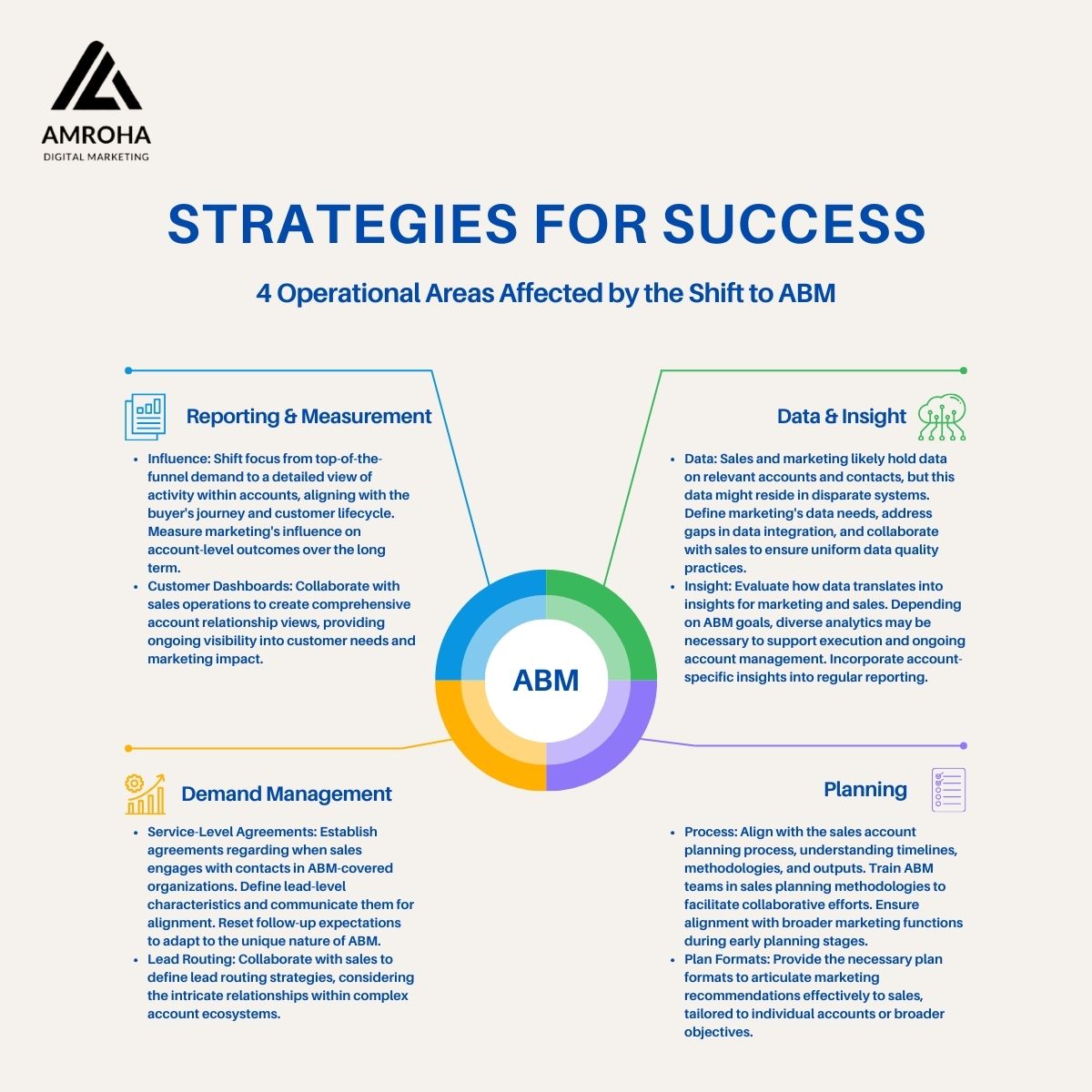
One: Data and Insight
The foundational elements of ABM revolve around an organization’s understanding of its customers and/or prospects, and the strategic utilization of this data for data-driven decision-making.
- Data: Sales and marketing likely maintain data on relevant accounts and contacts, but these datasets may reside in disparate systems. Clearly define marketing’s information needs concerning accounts and contacts, identifying gaps in data breadth and depth. Prioritize better integration of data across systems, recognizing that the required level of detail for effective ABM differs from that needed for demand gen marketing. Collaborate with sales to establish shared data quality practices, ensuring accurate linking of contacts to accounts and associated opportunities.
- Insight: Evaluate how data is leveraged for insight generation in marketing and sales, encompassing basic segmentation to advanced analytics for retention and propensity to buy. Depending on ABM goals, various analyses may be necessary to support opportunity-related execution and ongoing account management. If marketing lacks widespread analytics usage, explore the availability of required skills or services from other organizational functions or external agencies, such as Megadeals. Diverse analytics types (e.g., account segmentation, marketing mix analysis, propensity-to-buy modeling, retention risk modeling) can enhance account-based efforts. Ongoing reporting requirements should encompass insights about each account and its associated contacts.
Two: Strategic Planning Adaptation
Marketing teams accustomed to planning for segments with demand gen based objectives must undergo a transformation in their planning models to effectively support ABM. Key areas of focus in this shift include:
-
Process: ABM planning aims to align with specific account goals while minimizing redundant execution. Marketing must comprehend and synchronize with the existing sales account planning process for ABM-involved accounts, encompassing the planning timeline, methodology, and output. Successful account-based marketers are often trained in the sales planning methodology to understand the sales requirements and provide air cover for sales prospecting. To ensure alignment, they collaborate within the sales planning process to integrate the marketing component of the plan. Once sales goals are defined and marketing-supported goals are chosen, account-based marketers must integrate with other marketing functions, particularly product or service marketing and those planning broader campaigns. Early in the planning stages, ABM teams should communicate large-account goals, enabling adjustments to high-level campaign themes if necessary. This ensures that those outside ABM planning are informed of the needs and objectives within the largest and/or highest-potential accounts. Additionally, collaboration with product, solution, or service groups is essential to incorporate new offerings or relevant changes into ABM and sales plans. A comprehensive understanding of the types and timing of tactics planned for other marketing objectives, ranging from events to communities to e-books, enables resource-constrained ABM teams to leverage existing work to meet their needs.
-
Plan Formats: Depending on the accounts involved, individual plans may be necessary to support account-specific objectives. Alternatively, marketing can support similar opportunity or relationship development objectives across multiple accounts. Operations must provide the requisite plan formats to facilitate the development, output, and presentation of marketing’s recommendations to sales.
Three: Demand Management
When marketing transitions to cultivating demand within a specific set of accounts where sales has established relationships, new protocols for demand management must be established. Key considerations include:
-
Service-level Agreements: Sales typically engages with contacts in organizations covered by an ABM model at an earlier stage of the buyer’s journey compared to other accounts. To ensure alignment, new lead-level definitions and characteristics must be mutually agreed upon and effectively communicated. Adjustments to follow-up expectations may also be necessary as salespeople determine the optimal approach for advancing an opportunity and identify essential contacts to achieve this.
-
Lead Routing: Particularly in complex account ecosystems, numerous sales roles are involved in managing opportunities from initial contact to closure. Marketing and sales collaboration is crucial to defining which roles will receive specific notifications, encompassing both contact-level activity and leads. The efficacy of lead routing in an ABM context relies on the quality of data linking contacts to accounts.
Four: Reporting and Measurement
Tracking marketing’s impact in an ABM model poses distinct challenges compared to a demand creation-driven approach, requiring adaptations in reporting and measurement strategies. Key considerations include:
-
Influence: Since sales pipeline acceleration in ABM differs, traditional measurement methods that focus on the top of the sales funnel is less relevant. Instead, emphasis should be placed on creating a comprehensive view of activities within accounts. This involves analyzing the timing of activities concerning the buyer’s journey and customer lifecycle, correlating them with revenue and relationship outcomes. The goal is to capture the nature and extent of marketing’s influence on account-level results. Given the longer sales cycles in many ABM opportunities, influence measurement should extend to provide a long-term perspective.
-
Customer Dashboards: Exclusive focus on the buyer’s journey in reporting neglects post-sales impact, limiting visibility into customer needs and marketing effectiveness. Collaborative efforts between marketing and sales operations are essential to develop a holistic view of each account relationship. While particularly crucial for large accounts, a more streamlined version is equally vital for the ongoing management of an extended list of named accounts.
Conclusion: Streamlining Operations for ABM Success
Transitioning to ABM demands operational finesse across data management, strategic planning, demand handling, and reporting. Operations leaders play a pivotal role in orchestrating these shifts:
- Data Management: Integrate datasets for comprehensive insights.
- Strategic Planning: Align marketing plans with sales objectives.
- Demand Handling: Define service-level agreements and optimize lead routing.
- Reporting: Adopt comprehensive metrics to gauge ABM impact.
By embracing these adaptations, operations leaders can effectively support ABM execution, driving sustained growth and customer relationships. Without such adjustments to align with ABM dynamics, marketing may find itself ill-equipped to harness the full potential benefits of this strategy.
Let’s Talk
Let’s talk about how I can help you with your ABM needs.
I take a strategic approach with focus on your accounts’ key initiatives and change drivers.
Fill out the form now and let’s discuss your ICPs’ key initiatives and change drivers.