
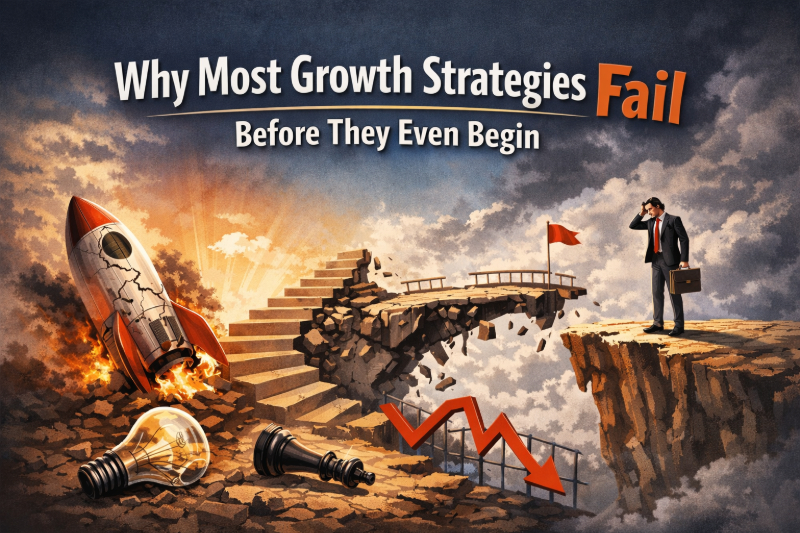
Founders and executives rarely fail because they lack ambition, intelligence, or capital. More often, they fail because their growth strategy is built on activity rather than clarity.
Marketing plans are created. Campaigns are launched. Budgets are approved. Metrics are tracked. Yet results remain inconsistent, fragile, or impossible to scale.
The uncomfortable truth is this: most growth strategies fail long before execution. They fail at the point where leadership confuses motion with direction.
This article is not about tactics. It is about the structural decisions that separate durable growth from short-lived momentum.
The Hidden Cost of Tactical Obsession
Modern organizations are surrounded by tactical noise. Every week introduces a new channel, tool, framework, or growth hack. Boards ask about pipelines. Investors ask about CAC. Teams ask what to ship next.
In response, leadership often accelerates activity:
- More content
- More ads
- More outbound
- More tools
- More reporting
What rarely increases is clarity.
When strategy is unclear, tactics become a substitute for thinking. Teams stay busy, but progress stalls. Growth becomes reactive instead of intentional.
This is not a marketing problem. It is a leadership problem.
Strategy Begins With Choosing What Not to Do
One of the most common executive mistakes is believing that growth comes from expanding reach. In reality, growth comes from narrowing focus.
Strong strategies are defined by exclusion:
- Which buyers are we deliberately not pursuing?
- Which problems are we explicitly choosing not to solve?
- Which revenue opportunities are distractions, not priorities?
Without these decisions, organizations drift into generic positioning. Messaging becomes vague. Value propositions weaken. Sales cycles lengthen.
Clarity creates force. Diffusion creates friction.
The Founder Fallacy: “We Know Our Market”
Founders often believe they understand their market better than anyone else. In the early days, this is usually true. As the company grows, it becomes dangerously false.
Markets evolve. Buyers change roles. Decision criteria shift. What once differentiated you becomes table stakes.
Yet many leadership teams continue to operate on assumptions formed years earlier:
- “Our buyer is the same as before”
- “Our value is obvious”
- “The market understands what we do”
When assumptions replace evidence, strategy becomes detached from reality. Marketing starts explaining rather than persuading. Sales starts discounting instead of differentiating.
The result is not failure. It is stagnation, which is often worse.
Growth Is Not a Marketing Function
Another persistent misconception is that growth lives inside marketing.
Marketing supports growth. It does not create it.
Growth is the output of alignment across leadership decisions:
- Product strategy defines what can be monetized
- Pricing strategy defines how value is captured
- Sales strategy defines how value is communicated
- Marketing strategy defines how value is understood
When these decisions are misaligned, no amount of execution can compensate.
High-performing companies treat growth as a leadership discipline, not a departmental responsibility.
The Role of Thought Leadership Is Not Visibility
Thought leadership has been diluted into content volume. Publishing more articles does not make a company thoughtful. It makes it louder.
Real thought leadership does three things:
- It reframes the problem the buyer believes they have
- It introduces tension with the status quo
- It forces a choice
Founders and executives often avoid this because it feels risky. Clear points of view repel as much as they attract.
But growth does not come from pleasing everyone. It comes from resonating deeply with the right few.
Safe messaging creates safe results.
Strategy Without Measurement Is Just Opinion
Many leadership teams talk about strategy, but few define how it will be validated.
Strong strategies include clear signals:
- What must change if the strategy is working?
- What evidence would prove it is not?
- What behaviors should shift internally and externally?
Without these markers, strategy becomes storytelling rather than decision-making.
Executives should not ask, “Are we executing well?”
They should ask, “Is reality confirming our assumptions?”
That distinction separates leaders from operators.
The Executive Discipline of Saying “Not Yet”
One of the hardest leadership skills is restraint.
Opportunities will always appear attractive:
- New segments
- New geographies
- New products
- New partnerships
The question is not whether they are promising. The question is whether they are aligned.
Premature expansion creates complexity before competence. It dilutes focus before differentiation is established.
Sustainable growth favors sequence over speed.
What Founders and Executives Must Relearn
As organizations scale, leaders must unlearn habits that once served them:
- Instinct must give way to insight
- Speed must give way to sequencing
- Activity must give way to intent
The companies that endure are not the ones that move fastest. They are the ones that move deliberately, with clarity, and with conviction.
Growth is not accidental. It is designed.
Closing Thought
If your organization is busy but uncertain, active but unfocused, growing but fragile, the problem is not execution.
It is strategy.
And strategy is not a document. It is a series of disciplined decisions, reinforced every day by leadership behavior.
At Amroha Digital, we believe sustainable growth starts with clarity, not campaigns.
Success Story

Transforming Concierge Plus
As Marketing Director at Concierge Plus Inc., I spearheaded initiatives that propelled the company to new heights, amplifying brand awareness and driving significant increases in sales. Read success story now.
 Your B2B & Digital Marketing Agency